


 Cart
Cart
 sales@molnova.com



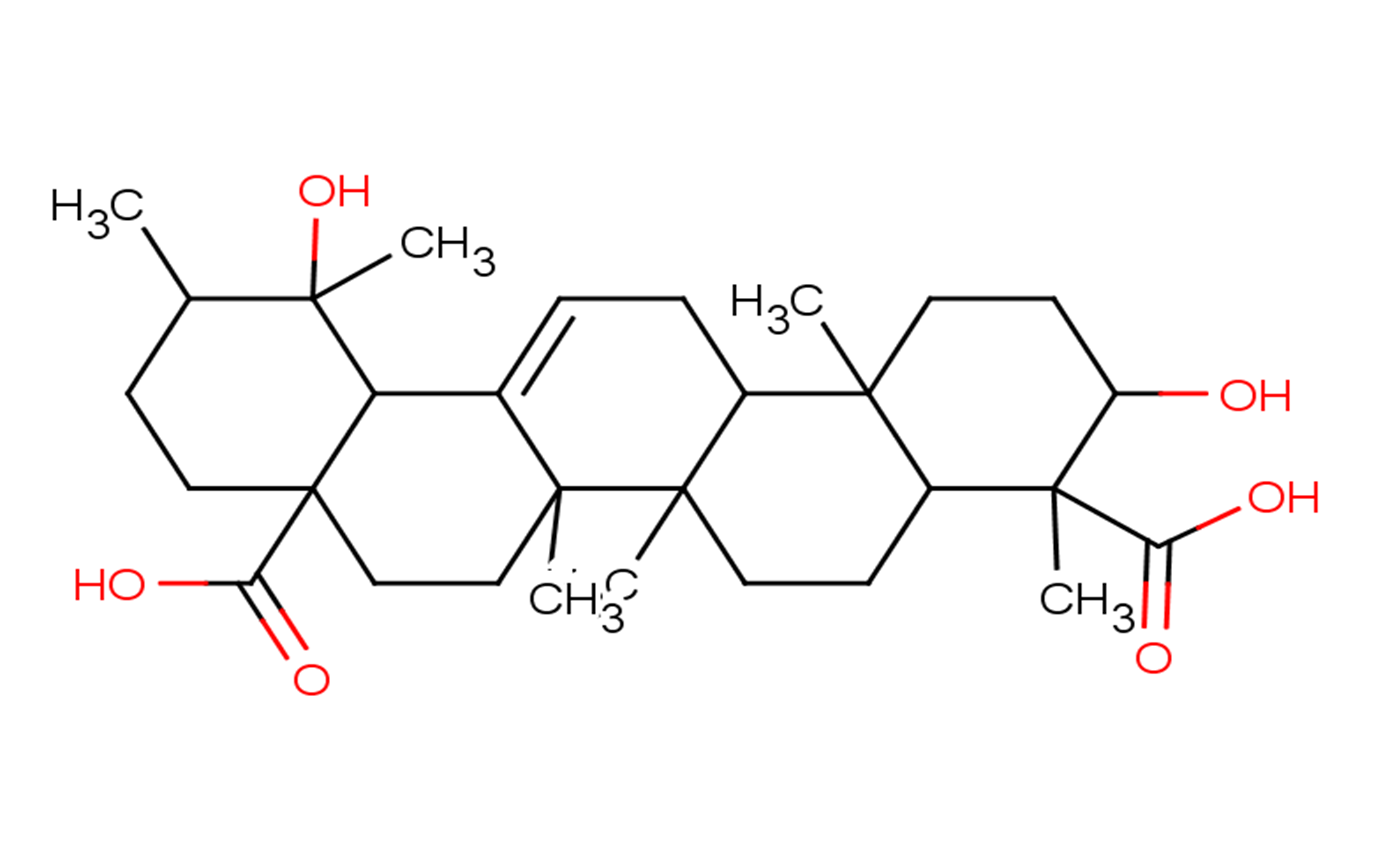
Ilexgenin A
CAS No. 108524-94-3
Ilexgenin A( —— )
Catalog No. M22855 CAS No. 108524-94-3
Ilexgenin A is a novel pentacyclic triterpenoid, is a compound extracted from leaves of Ilex hainanensis MerrIlexgenin A (IA), a novel pentacyclic triterpenoid, is a compound extracted from leaves of Ilex hainanensis Merr.treatment with IA attenuated atherosclerosis in high-fat diet-induced apolipoprotein E deficient mice via a series of effects involving regulation of lipid parameters, decrease of atherosclerosis-related indexes, inhibition of inflammatory cytokines secretion and pathological changes of main organs.?
Purity : >98% (HPLC)
 COA
Datasheet
HNMR
HPLC
MSDS
Handing Instructions
COA
Datasheet
HNMR
HPLC
MSDS
Handing Instructions
| Size | Price / USD | Stock | Quantity |
| 5MG | 140 | In Stock |


|
| 10MG | 215 | In Stock |
|
| 25MG | 327 | In Stock |
|
| 50MG | 484 | In Stock |
|
| 100MG | 691 | In Stock |
|
| 200MG | Get Quote | In Stock |
|
| 500MG | Get Quote | In Stock |
|
| 1G | Get Quote | In Stock |
|
Biological Information
-
Product NameIlexgenin A
-
NoteResearch use only, not for human use.
-
Brief DescriptionIlexgenin A is a novel pentacyclic triterpenoid, is a compound extracted from leaves of Ilex hainanensis MerrIlexgenin A (IA), a novel pentacyclic triterpenoid, is a compound extracted from leaves of Ilex hainanensis Merr.treatment with IA attenuated atherosclerosis in high-fat diet-induced apolipoprotein E deficient mice via a series of effects involving regulation of lipid parameters, decrease of atherosclerosis-related indexes, inhibition of inflammatory cytokines secretion and pathological changes of main organs.?
-
DescriptionIlexgenin A is a novel pentacyclic triterpenoid, is a compound extracted from leaves of Ilex hainanensis MerrIlexgenin A (IA), a novel pentacyclic triterpenoid, is a compound extracted from leaves of Ilex hainanensis Merr.treatment with IA attenuated atherosclerosis in high-fat diet-induced apolipoprotein E deficient mice via a series of effects involving regulation of lipid parameters, decrease of atherosclerosis-related indexes, inhibition of inflammatory cytokines secretion and pathological changes of main organs.?The underlying mechanism of IA was investigated on oxidized low-density lipoprotein (Ox-LDL)-induced THP-1 cells.?Pre-treatment with IA decreased active inflammation cytokines involving interleukin-6 (IL-6), IL-1 and tumor necrosis factor-α (TNF-α) expression in a concentration-dependent manner.IA inhibited the phosphatidylinositol 3-kinase (PI3K), protein kinase B (Akt), IKKα phosphorylation and NF-κB activity induced by Ox-LDL.?Overall, these findings define IA as a novel drug candidate for anti-atherosclerotic therapy.(In Vitro):Ilexgenin A (0~100 μM; 24 hours; HT 29 and HCT 116 cells) effectively decreases cell viability in HT 29 and HCT 116 cells.Ilexgenin A (12.5~50 μM; 24 hours; HT 29 cells) downregulates the expression of SREBP-1, inhibits the translocation of SREBP-1 to the nucleus and decreases the content of TG.Ilexgenin A (12.5~50 μM; HT 29 and HCT 116 cells) induces cell cycle arrest at G1 phase in colon cancer cells.Ilexgenin A (12.5~50 μM; 24 hours; HCT 116 cells) modulates lipid metabolism. Ilexgenin A (50 μM; 24 hours; HT 29 and HCT 116 cells) regulates SREBP-1 by inhibiting HIF1α.Ilexgenin A inhibits fatty acids synthesis.(In Vivo):Ilexgenin A (20 mg/kg) ameliorates the AOM/DSS induced carcinogenesis. Ilexgenin A can regulate lipid metabolism. Ilexgenin A decreases the expression of SREBP-1 and HIF 1α in AOM/DSS mice.
-
In VitroIlexgenin A (0~100 μM; 24 hours; HT 29 and HCT 116 cells) effectively decreases cell viability in HT 29 and HCT 116 cells.Ilexgenin A (12.5~50 μM; 24 hours; HT 29 cells) downregulates the expression of SREBP-1, inhibits the translocation of SREBP-1 to the nucleus and decreases the content of TG.Ilexgenin A (12.5~50 μM; HT 29 and HCT 116 cells) induces cell cycle arrest at G1 phase in colon cancer cells.Ilexgenin A (12.5~50 μM; 24 hours; HCT 116 cells) modulates lipid metabolism. Ilexgenin A (50 μM; 24 hours; HT 29 and HCT 116 cells) regulates SREBP-1 by inhibiting HIF1α.Ilexgenin A inhibits fatty acids synthesis. Cell Viability Assay Cell Line:HT 29 and HCT 116 cells Concentration:0~100 μM Incubation Time:24 hours Result:Effectively decreased cell viability in HT 29 and HCT 116 cells.Western Blot Analysis Cell Line:HT 29 cells Concentration:12.5~50 μMIncubation Time:24 hours Result:Downregulated the expression of SREBP-1. RT-PCRCell Line:HT 29 cells Concentration:12.5~50 μM Incubation Time:24 hours Result:Decreased the content of TG.Immunofluorescence Cell Line:HT 29 cells Concentration:12.5~50 μM Incubation Time:24 hours Result:Inhibited the translocation of SREBP-1 to the nucleus.
-
In VivoIlexgenin A (20 mg/kg) ameliorates the AOM/DSS induced carcinogenesis. Ilexgenin A can regulate lipid metabolism. Ilexgenin A decreases the expression of SREBP-1 and HIF 1α in AOM/DSS mice.
-
Synonyms——
-
PathwayApoptosis
-
TargetIL Receptor
-
RecptorIL Receptor|TNF-α
-
Research Area——
-
Indication——
Chemical Information
-
CAS Number108524-94-3
-
Formula Weight502.69
-
Molecular FormulaC30H46O6
-
Purity>98% (HPLC)
-
SolubilityIn Vitro:?DMSO : 100 mg/mL (198.93 mM)
-
SMILESCC1CCC2(CCC3(C(=CCC4C3(CCC5C4(CCC(C5(C)C(=O)O)O)C)C)C2C1(C)O)C)C(=O)O
-
Chemical Name——
Shipping & Storage Information
-
Storage(-20℃)
-
ShippingWith Ice Pack
-
Stability≥ 2 years
Reference
1. Inhibition of lipolysis by ilexgenin A via AMPK activation contributes to the prevention of hepatic insulin resistance. Eur J Pharmacol. 2017 Oct 15;813:84-93.
molnova catalog



related products
-
Apilimod 2HCl
Apilimod 2HCl (STA 5326 2HCl) is a PIKFYVE kinase inhibitor that promotes NLRP3 inflammatory vesicle activation, IL-1β secretion, and cellular pyroptosis, and is used in the study of amyotrophic lateral sclerosis.
-
Secukinumab B
Secukinumab is a fully humanized monoclonal anti-IL-17A antibody and the first in its class to be approved by the US Food and Drug Administration for the treatment of moderate to severe plaque psoriasis.
-
YM-90709
A potent IL-5 receptor antagonist that inhibits the binding of IL-5 to its receptor on peripheral human eosinophils and butyric acid-treated eosinophilic HL-60 clone 15 cells with IC50 of 1.0 and 0.57 uM, respectively.
